
News

When we remember the horrific events of September 11, 2001, we usually think of planes crashing into the Twin Towers in New York City. That surely is the first thing that comes to mind for me.
But we must not forget 2 more planes were hijacked that day. United Airlines flight 93 crashed in a field near Shanksville, PA when the passengers fought back and forced the hijackers to crash the plane, killing all 44 passengers and crew. The hijackers of American Airlines flight 77 deliberately crashed their hijacked plane in to the Pentagon, the headquarters of the US armed forces. All 59 passengers on the plane and another 125 people in the building were killed that day.
To honor and remember the 184 lost souls, a memorial was constructed near the Pentagon’s west wall, adjacent to where fight 77 originally crashed into the building. The beautifully landscaped memorial is designed by Julie Beckman and Keith Kaseman.

There are 184 illuminated benches at the memorial. One for each of the victims. Each bench is engraved with the name of one of the victims. The benches are arranged in rows by year of birth of the victims. The youngest victim at age 3 was born in 1998, the oldest victim was born in 1930. The victims that were on board of flight 77 have their bench facing the Pentagon. Those who rushed out of the Pentagon in an attempt to rescue victims have their bench facing away from the building. Walkways border the exact path of the American Airlines plane as it plowed into the building.
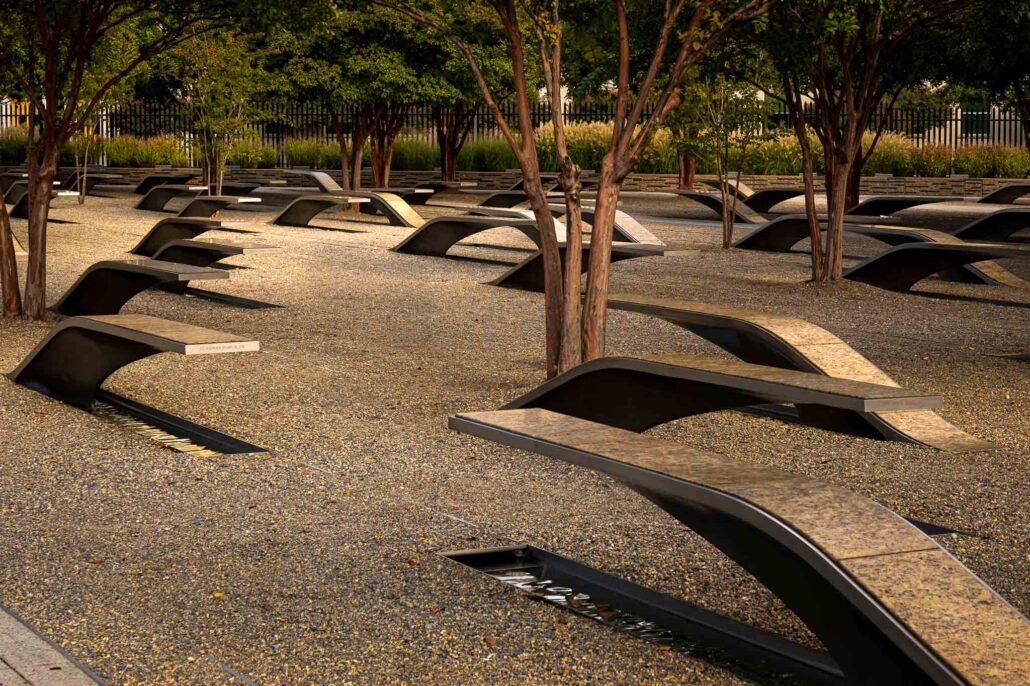


I sat down next to the 1970 marker—the year of my birth—with mixed emotions. I felt incredibly sad at the loss of life. The idea that the victims of the horrible attack were robed of living a full life is just heartbreaking.

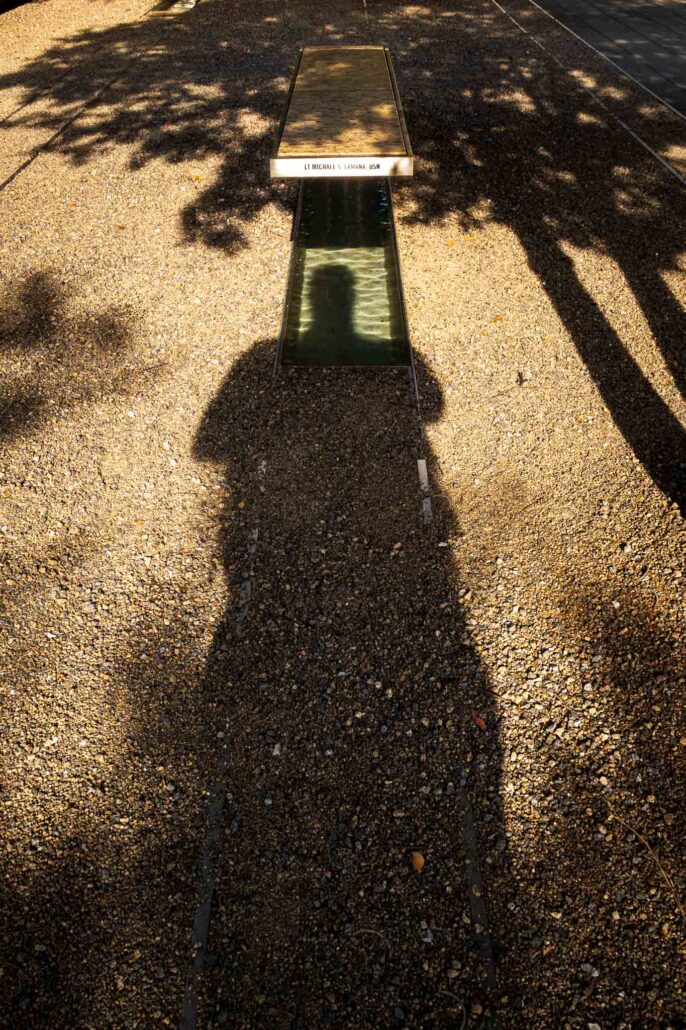
At the same time, I felt happy to be alive and healthy. I felt grateful for not having to endured the hardships that the victims and their families had to endure. I am grateful I still get to travel the world and enjoy freedom, happiness and good food. All things I do not take for granted. All things the terrorists took away from those 184 unfortunate souls at the Pentagon on the morning of Tuesday, September 11, 2001.

I still have to make my way to Shanksville, PA to visit the Flight 93 National Memorial. That will happen some day, I am sure. For now, I am grateful that I got to visit the National 9/11 Pentagon Memorial on my 2025 trip to Washington DC.
The Empire of Japan and the Allied Forces formally agreed to an unconditional Japanese surrender in World War II on September 2nd, 1945. When leaders from Japan, the U.S.A., UK, France, China, the USSR and others signed the Instrument of Surrender aboard the USS Missouri in Tokyo Bay, it effectively ended World War II. At present there is copy of the document on display on the USS Missouri in Pearl Harbor, HI.

(photos from my 2001 trip to Hawai‘i)

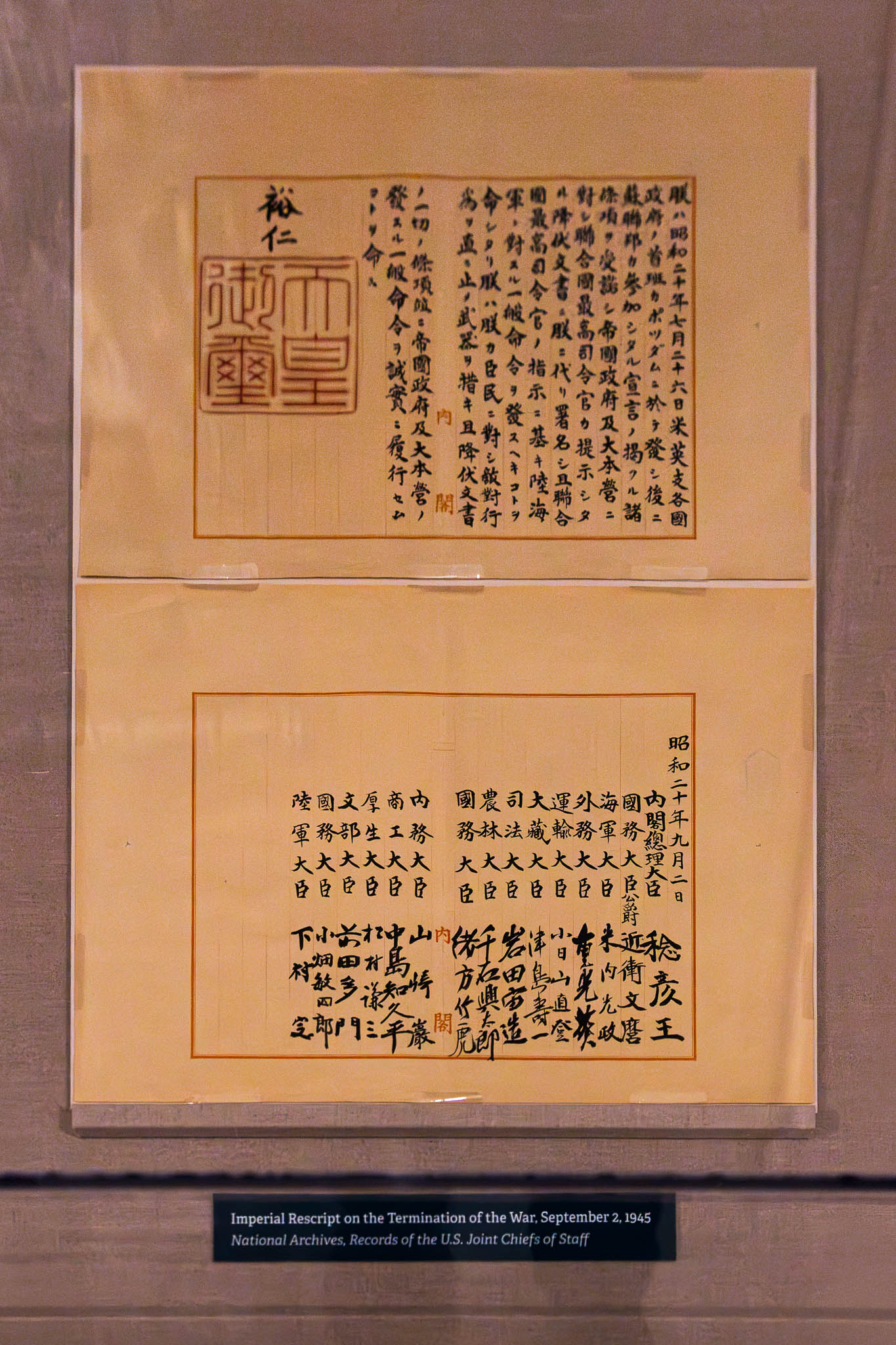
I visited the National Archives Museum in Washington DC in the fall of 2025. The Japanese translation of the Instrument of Surrender was on display at the museum at that time. I never realized that the Japanese official party understood little or no English and the document had to be translated. Until I saw the document of course.


In the early morning of August 6, 1945 a Boeing B-29 Superfortress left the small island of Tinian with a crew of 12 under the command of Colonel Paul Tibbets Jr. Their destination: the city of Hiroshima, on the home islands of Japan. Their payload: 1 single bomb… A 15 kiloton nuclear bomb named Little Boy.
The atomic bomb was released from the B-29 bomber at 8:15H on August 6, killing around 80000 persons in a split second.
Col. Tibbets named the B-29 Superfortress that dropped that 1st atomic bomb Enola Gay. After his mother! The US Air Force decided to preserve Enola Gay when World War II ended. The plane was handed to the Smithsonian National Air & Space Museum very quickly after the war. It was is storage for a long time. But Enola Gay was meticulously restored. It took 300000 staff hours to return it to its original state. It was put on display at the museum in December 2003.

It is an important historical artifact. I consider it to be a constant reminder that war is an atrocious thing. It is a reminder that nuclear war would destroy humanity and our beautiful planet. As the OMD song says:”Enola Gay, you should have stayed at home yesterday.”

It is big though! I walked around it several times, sat down and looked at it. I spent almost an hour with this plane. It is impressive. And it triggered a lot of mixed feeling with me.


On September 12, 1962 at Rice University Stadium in Houston, TX president Kennedy spoke these historic words: “We choose to go to the Moon. We choose to go to the Moon in this decade and do the other things, not because they are easy, but because they are hard, […]”.
On July 20, 1969 2 NASA astronauts made good on JFK’s words on the Apollo 11 mission. Astronauts Neil Armstrong and Buzz Aldrin spent little less than a day on the moon. All the while, Michael Collins circled the moon. Neil Armstrong was the 1st of only 12 men that ever stepped foot on an other celestial body other than Earth.
Apollo 11’s command module is on display at the Smithsonian’s National Air and Space Museum In Washington DC. It goes without saying that I just had to go and see it when I visited Washington DC last year. I spent over 15 minutes gawking at this piece of history. This spacecraft went to the moon! It went to the moon and then came back. And what always strikes me is how tiny the spacecraft is. I find it hard to imagine living it such tight quarters with 3 persons for about 10 days or so.


Neil Armstrong’s actual spacesuit is on display next to the Apollo 11 command module. These 2 items are really a piece of history.


I welcomed the lovely Ashley to my studio once more. Shooting a mix of her own outfits and some latex. She had these cargo pants and boots in her bag that we combined laced sheer top. We’ve got a beautiful portrait and some more edgier shots out of the outfit.


A quick outfit change to add some latex and high heels to Ashley’s outfit gave her a totally different look.


Joint Base Andrews was established in 2009 when Andrews Air Force Base merged with a US Naval Air Facility. Many will know JB Andrews—or at least Andrews AFB—as the home of Air Force One. Yep, that Air Force One: the modified Boeing 747 the US president uses.
Actually, the US Air Force 89th Airlift Wing is one of several units that call JB Andrews home. And the 89th Airlift Wing not only operates Air Force One but also a couple other modified Boeing models used for aerial transport of senior US officials and VIP’s.
You can imagine I headed out to the 2025 JB Andrews air show with a sliver of hope on seeing Air Force One. Alas, the big bird didn’t show itself. But I got to see a C-32, a modified Boeing 757, and a C-40, a modified 737, from the 89th Airlift Wing. Along with a host of other cool planes and displays.


How about the Lockheed Martin C-5 Galaxy? Talking about big birds! Or the F/A-18 Super Hornet of the US Navy’s Rhino Team. I would see it again at the 2025 NAS Oceana a week later. They fly an impressive demo for sure.


There was time of some vintage aviation too. Like the Bell Helicopters UH-1 Iroquois for example. Not true vintage ’cause this aircraft is still in service with the 1st Helicopter Squadron operating out of JB Andrews. Did you know the Huey as the UH-1 is more affectionately called, came in to service in the 1950’s and is still in service with the US Air Force until this date?

But the Lockheed T-33 Shooting Star up next is truly a vintage jet. This particular airplane belongs to the Ace Maker Aviation team and is no longer in service.


And what about the North American B-25 Mitchel “Panchito” belonging to the Delaware Aviation Museum? Ain’t she pretty. In Europe, we’re used to seeing the Mitchel in cameo green. The sleek silver body of Panchito is something else though.

The cherry on the cake definitely were the US Air Force Thunderbirds. 6 General Dynamics–now Lockheed Martin–F-16’s painted in the most beautiful red, white and blue color scheme. 6 of the US Air Force’s best pilots fly that Viper as close at 18 inches (46cm) apart at speeds up to 500 mph (800 km/h). Absolutely breathtaking! And make sure they don’t surprise you with their sneak pass at 700 mph (1100 km/h).


Did you notice that the paint scheme on Thunderbird 5 is slightly different than the others? Go back to the photo of the Thunderbirds Calypso Pass. The photo were Thunderbirds 5 and 6 seem to be mirrored. Pay close attention to the way the 5 is painted on the side of the Viper of Thunderbird 5. It’s painted upside down because Thunderbird 5 is inverted for most of the show.

The other day, I stumbled on a sparrowhawk enjoying his lunch in my backyard. The little rascal caught a dove and quietly devoured it. He let me get pretty close and photograph him. I got within like 8 yards of him to snap some photos. Not a sight I see every day.


No better way to say “good morning” to an air show crowd on a US Navy base than flying the US Navy flag. A beautiful way to celebrate the 250th anniversary of the US Navy btw. Welcome to NAS Ocena!

Oceana Naval Air Station is located near Virginia Beach, VA on the eastern seaboard of the continental U.S.A. The base is home to the US Navy’s Carrier Air Wings CVW-1, CVW-3, CVW-7 and CVW-8. Trust me, that’s a whole lotta F/A-18 Hornets that live there.
Before the US Navy and US Air Force jets took the stage, the US Coast Guard showed off their assets. They displayed their version of the C-130 Hercules. And the Sikorsky MH-60 Jayhawk, the coast guard version of the formidable Black Hawk helicopter. Both planes are seldom seen in the skies of Europe. Not even at air shows.


I had not seen a F-22 Raptor demo. But, wow, it met and exceeded my expectations. It was spectacular. The Lockheed Martin F-22 Raptor is 5th generation fighter. Its powerful engines and trust vectoring nozzles make it powerfull and very maneuverable at the same time. And as a bonus for the demo, we got flares. Lots of it.


The Marines showed off their Lockheed Martin F-35 Lightning II, the B version. And the Navy had their Rhino demo team present the Boeing F/A-18E/F Super Hornet.


I told you there’s a lot of Hornets at NAS Oceana. And we’re not done yet…
6 more Hornets flanked a Grumman E-2 Hawkeye for the fleet flyby. A personal highlight ’cause I think the Hawkeye is a very cool plane. You can imagine I enjoyed the Hawkeye demo to followed the fleet flyby a lot.


The absolute highlight of the day was the demonstration team of the US Navy: the Blue Angels. No air show on a naval air station would be complete without them. 6 Boeing F/A-18 E/F Super Hornet planes flying only a mere 18 inches apart on some occasions. Simply breathtaking and jaw dropping! They turn flying an airplane into an art form.


And don’t forget they are supported by a beautiful Lockheed Martin C-130J Super Hercules nicknamed Fat Albert.


We had some northern lights over Belgium the other day. And that does not happen very often. An aurora borealis (northern lights) is usually observed in the arctic region. When it’s observed as far south as Belgium, it creates a buzz. It was all over social media.
I had never seen an aurora borealis with my own eyes. So when I saw the news, I went out to check on it. I caught the tail end of the event. I guess it was around 23:30H. But it was still clearly visible as a greenish yellowish hue in the sky. Quickly grabbed a tripod and my little Canon Powershot G7x III and shot this photo from my backyard.


I could not make it to last year’s edition of the Light of Day concert in Belgium ‘cause I was out of town. But I wouldn’t want to have missed this year’s for the world.
I had a lot of fun. Seeing friends again, hearing familiar songs and on top of it all I had the privilege of taking pictures again. Artists this year included Jesse De Belder from Alps, Guy Davis, Adam Ezra & Corrina Smith, Jake Thistle, Rob Dye and of course Joe D’Urso.


The Light of Day Foundation, Inc., utilizes the awesome power of music to raise money and awareness in our continuing quest to end Parkinson’s disease and related neuro-degenerative diseases, specifically Progressive Supranuclear Palsy (PSP) and Amyotrophic Lateral Sclerosis (ALS), within our lifetime. It was founded by Bob Benjamin in 2000. A concert in Belgium is staged since 2013.